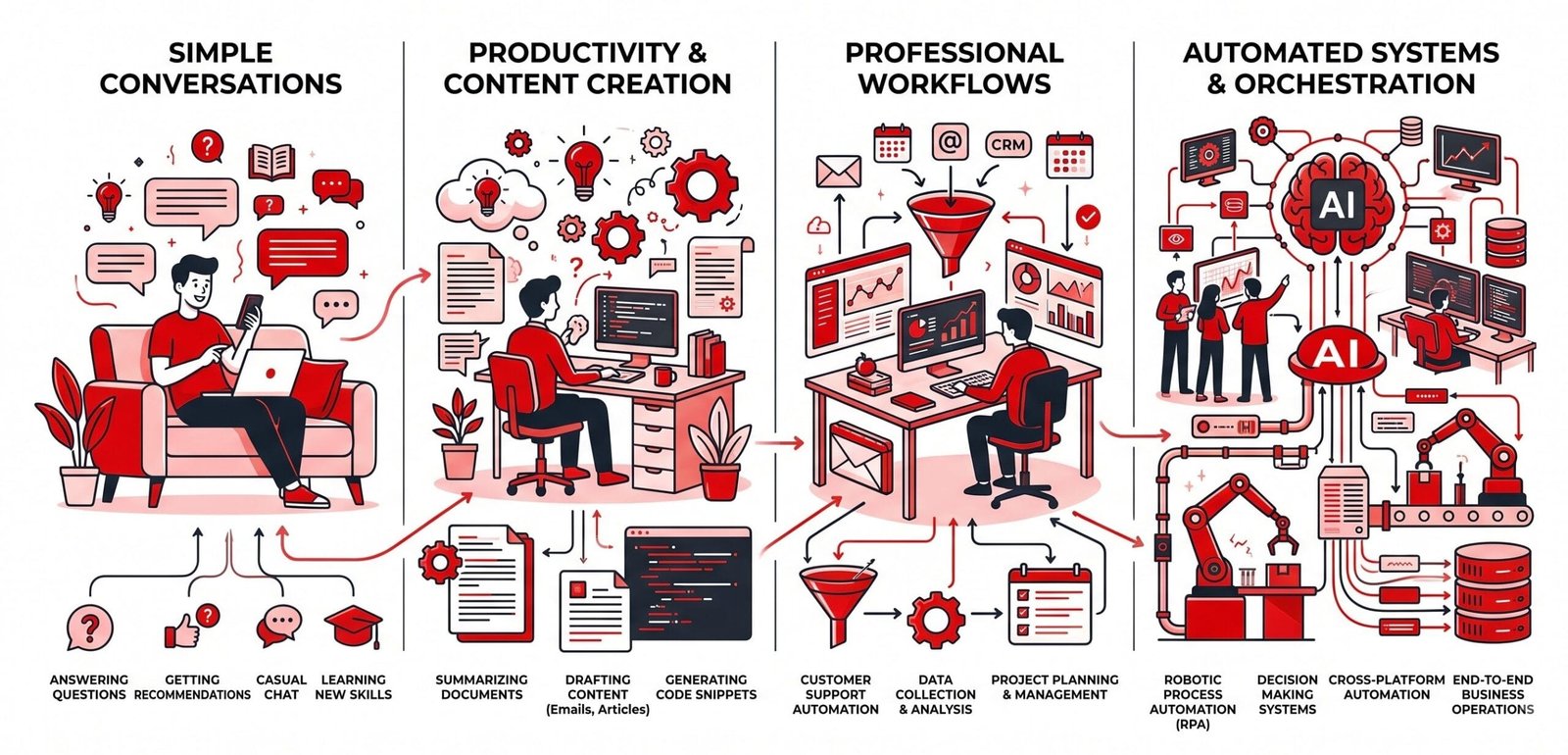
From simple conversations to automated workflows and systems, today, businesses are using them to communicate with customers, automate repetitive tasks, support employees, collect information, and keep workflows moving 24/7.
AI chatbots are no longer just tools that answer questions.
The interesting part is not simply “Can a chatbot talk?”
The real question is: “What work can a chatbot take off a person’s plate?”
# 1. Customer Support — Beyond FAQs
One of the most common uses of AI chatbots is customer support.
Instead of waiting for a support executive, the chatbot can provide immediate answers and transfer complex issues to a human when necessary.
*AI handles the repetitive questions. People handle the conversations that actually need people.*
# 2. Lead Generation
Chatbots are also becoming a part of sales workflows.
Instead of simply displaying a “Contact Us” form, a chatbot can start a conversation.
The chatbot can collect basic requirements, contact details and preferences before passing the lead to the sales team.
This means sales teams spend less time collecting basic information and more time having meaningful conversations.
# 3. Appointment & Booking Automation
Another practical use is scheduling.
People can interact with a chatbot instead of going through multiple screens, users can simply **tell the chatbot what they need.**
# 4. Employee Assistance
AI chatbots aren’t only for customers.
Companies are using internal chatbots to help employees find information quickly.
The chatbot can search approved company information and provide an answer without employees having to search through multiple documents or ask HR every time.
# 5. E-Commerce Assistance
Online shopping is another area where chatbots are becoming useful.
Instead of browsing through hundreds of products, customers can describe what they want.
The chatbot can understand the request and guide the customer toward relevant products.
The experience becomes less like *searching a website* and more like *having a conversation with a shopping assistant.*
# 6. Healthcare Support
Healthcare is another area where conversational AI can support non-clinical workflows.
However, healthcare chatbots require additional safeguards.
A chatbot should not simply generate an answer and present it as medical advice.
For sensitive healthcare use cases, organizations need *controlled information sources, privacy protection, access controls, audit logs, and clear escalation to healthcare professionals.*
# 7. Collecting Information
A traditional form asks users to fill out multiple fields.
A chatbot can make the same process conversational.
The chatbot can collect structured information while allowing the user to communicate naturally.
This can be useful for customer support, onboarding, service requests and internal workflows.
# 8. Automating Actions – The Next Step
This is where automated chatbots become more interesting.
A chatbot doesn’t necessarily have to stop at answering a question.
It can potentially trigger an action.
The chatbot becomes more than a conversational interface.
It becomes a *gateway to business processes.*
# The Shift: From Chatbots to AI Agents
Traditional chatbots were often built around predefined questions and answers.
Modern AI systems can understand natural language, retrieve relevant information, maintain conversational context and, when properly integrated, interact with business systems.
That creates a different model:
*Ask → Understand → Retrieve → Decide what action is allowed → Execute → Confirm*
But automation should not mean giving an AI unlimited access.
Because the goal isn’t to automate *everything*.
The goal is to automate the *right things*.
# The Real Value of AI Chatbots
The biggest value of an AI chatbot isn’t that it can have a conversation.
It’s that the conversation can become an entry point to a workflow.
*Question → Information → Action → Outcome*
That’s where businesses can start moving from simple chatbot experiences toward genuinely useful AI-powered automation. Xnotch iTech Ventures builds ai automation to grow and scale businesses without losing their voice.