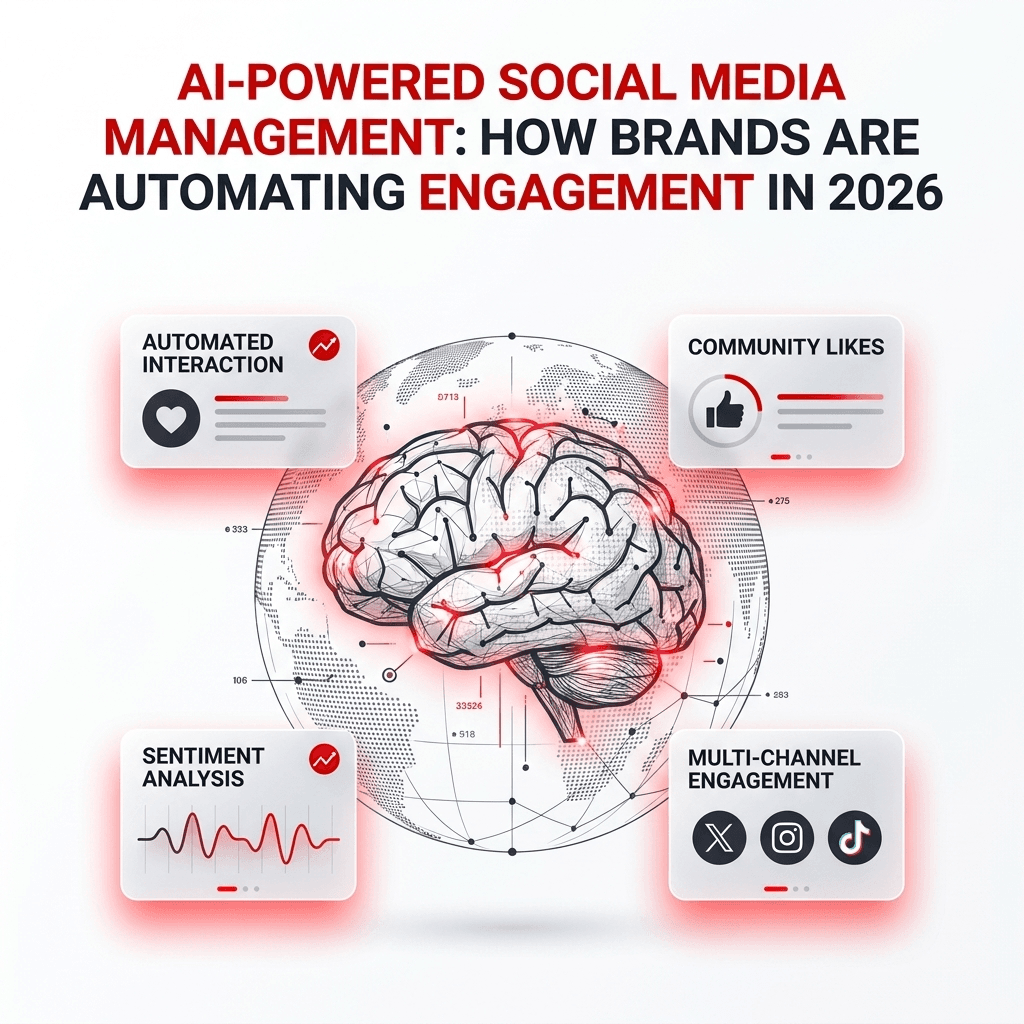
Scheduling was just the beginning. Here’s how autonomous AI agents took over social execution this year — and where human judgment still has to lead.
Social media automation used to mean one thing: scheduling. You wrote the post, picked a time slot, and a tool published it for you. Everything else — the strategy, the writing, the trend-spotting, the replies — still needed a human at the keyboard.
That model is gone. In 2026, the biggest shift in social media has been from AI-assisted tools to fully agentic management, where AI agents operate accounts autonomously — creating content, publishing across platforms, engaging audiences, and adjusting strategy based on real-time performance. The role of the human social media manager has moved from operator to strategist and editor.
From scheduling tool to autonomous teammate
The numbers reflect how fast this happened. Nearly 90% of social media marketers now use AI tools daily or several times a week, and AI-driven automation is estimated to cut manual workload by up to 70% while keeping engagement and content quality consistent. On the enterprise side, more than half of enterprise marketing teams have already deployed or are piloting agentic AI systems in at least one marketing channel.
What changed is scope. Modern platforms don’t just post — they handle the full loop:
Content ideation and drafting — generating on-brand captions, images, and short-form video concepts tailored to each platform and audience segment
Trend detection — surfacing what’s about to peak before competitors catch it, rather than reacting after the fact
Scheduling intelligence — factoring in seasonality, competitor activity, and real-world events, not just historical engagement
Community management — triaging comments and DMs, answering routine questions, and flagging anything that needs a human
Reporting — pulling cross-platform analytics into one dashboard instead of five separate exports
Why brands are moving fast on this ?
The business case is straightforward. Social automation is currently delivering an industry-average $5.20 return for every $1 spent, and agencies running AI-optimized campaigns are seeing considerably higher multiples on top of that. For a brand or agency managing several accounts, that efficiency compounds — the same output that once required a large team can now come from a much smaller one, freeing budget for strategy and creative instead of repetitive execution.
Platform providers are leaning in too. Meta, LinkedIn, and TikTok are all building AI capabilities directly into their advertising and content workflows, with Meta targeting fully automated ad generation by the end of 2026 — a signal of where the baseline is headed for everyone, not just early adopters.
The Catch: Automation without a voice is a liability.
Here’s the part brands keep getting wrong. The most common mistake in 2026 is automating the humanity out of a brand — because consumers still rank human-generated, authentic content as their top priority from the brands they follow. Purely AI-generated feeds create audience fatigue, and the brands winning right now are the ones that keep a visible human touch even as the backend runs on automation.
Starbucks runs centralized content strategy with localized automation across more than 35,000 locations — proof that automation scales a brand’s voice, it doesn’t replace it.
In practice, this means drawing a clear line:
- Automate : scheduling, first-draft copy, routine DM triage, performance reporting, trend surfacing
- Keep it humane : brand storytelling, responses to sensitive or reputational issues, genuine community relationships, and the culturally specific content that actually differentiates a brand
What this means for brands building their 2026 stack ?
If you’re deciding how deep to go on automation, a few guardrails hold up in practice:
- Set the voice and guardrails before you automate. AI agents are only as on-brand as the direction they’re given — skip this and you’ll end up rewriting generic output anyway.
- Match the tool to the account size, not the hype. A five-person retail brand and a 50-location franchise need very different levels of orchestration.
- Keep a human in the loop on engagement, not just content. Comment and DM automation is where trust is won or lost fastest.
- Treat reporting as a decision tool, not a vanity dashboard. The value is in what changes because of the data — content mix, cadence, ad spend — not the report itself.
The brands pulling ahead in 2026 aren’t the ones that automated the most. They’re the ones that automated the right layer — execution — while keeping strategy, judgment, and voice firmly in human hands.
Building or auditing your brand’s AI social stack? Xnotch iTech Ventures helps brands design automation that scales without losing their voice.